In the beginning there was the fire truck… a 1920 Seagrave pumper. Thanks to Seattle Fire Chief Bill Fitzgerald's loan, the Pirates were accompanied by sirens from their birth at Coleman Dock on Pier 52 to their first SEAFAIR parade.
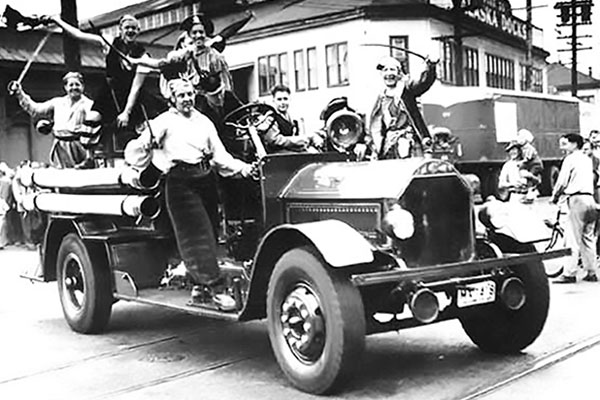
The 1920 Seagrave Pumper — the Pirates' first "vessel"
The Coast Guard later assigned a DUKW, (duck) a World War II landing craft, to Greater Seattle for the transportation of the Seafair Pirates, and assorted dignitaries during the SEAFAIR Celebrations.
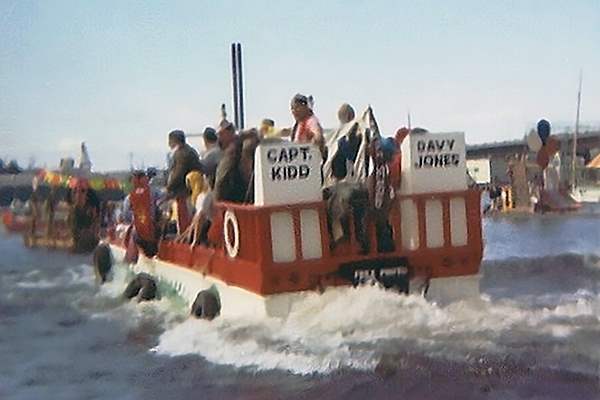
The Coast Guard DUKW assigned to Greater Seattle for Seafair
With the connivance of two congressmen and a few generals, it was time the Pirates had their own pirate ship.
Starting her life as a 1944 vintage amphibious landing craft, or DUKW, 'The Duck' came to the Seafair Pirates in 1954, adorned with a writhing Chinese dragon painted by the late Weaver Dial.

The Moby Duck, 1954 — her debut year, adorned with Weaver Dial's Chinese dragon
The now world-famous, Moby Duck made her debut in that year's SEAFAIR celebrations, and the Seafair Pirates have maintained and operated the Duck at their expense ever since.
Various schemes were tried, but the Duck always returned to a 'Spanish galleon' design, the better to announce to the world that MOBY DUCK was indeed a genuine pirate ship.


The Moby Duck today — still in service, still a Spanish galleon